The Gut-Brain Connection in Horses
- Roots Mercantile
- 5 hours ago
- 5 min read
Why your horse's behavior, mood, and performance are rooted in gut health — and how to restore both through terrain-based care.
By Le Anna K. | Rooted Saviors | Biofield App | Stewards Under Pressure
If your horse is spooky, reactive, stiff to work with, or just not performing the way you know they're capable of — the answer might not be in their training. It might be in their gut.
The connection between a horse's digestive system and their brain is one of the most important and least talked-about relationships in equine health. It's called the gut-brain axis, and it runs in both directions: a troubled gut sends inflammatory and stress signals to the brain, and a stressed brain signals the gut to tighten, reduce blood flow, and slow down. Each makes the other worse.
This post is an introduction to that connection — what it means, what disrupts it in modern horses, and what restoring the gut terrain looks like in practical, terrain-based terms.
"The stomach is a mirror of the horse's overall wellbeing. You can't treat gastric ulcers and leave everything else the same." — Equine Health Week 2026
Why the Gut and Brain Are Inseparable
The gut is not just a digestive organ. It is the largest part of the immune system (housing roughly 80% of immune cells), the primary producer of serotonin (approximately 90% is made in the gut wall, not the brain), and one of the most complex neural networks in the body — often called the enteric nervous system or the 'second brain.'
In horses, this connection is especially significant because:
• Horses evolved as continuous grazers — their digestive system runs best with constant slow movement, not twice-daily grain meals
• Their stomach produces acid continuously, making them highly vulnerable to ulcers when fed infrequently or managed under stress
• Chronic stress constricts blood flow to the gut, directly damaging the mucosal lining
• The vagus nerve — which carries signals between gut and brain — is highly active in horses and directly influenced by emotional state
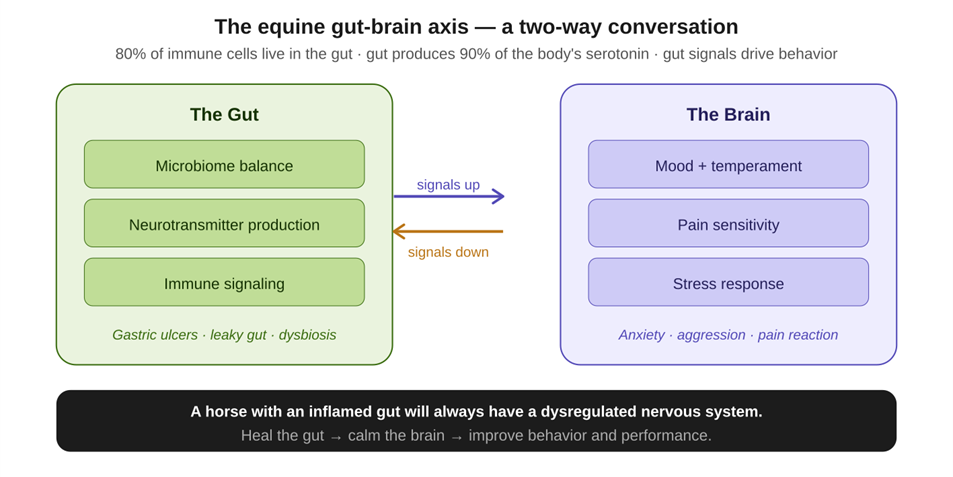
Figure 1: The gut-brain axis in horses — a two-way signaling system where gut inflammation drives behavioral and neurological changes.
What Disrupts It — The Modern Horse's Problem
Many common management practices create the exact conditions for gut-brain disruption:
Diet- High-starch, high-sugar diets spike blood glucose, ferment rapidly in the hindgut, and promote an acidic environment that destroys beneficial bacteria and damages the gut lining. Most commercial feeds were designed for convenience and weight gain, not for the horse's 70-million-year-old digestive design.
Stress and confinement- Cortisol directly reduces gut motility, suppresses immune activity in the gut wall, and increases gastric acid secretion. A horse that lives mostly in a stall is operating under chronic low-grade physiological stress regardless of how calm their environment appears.
NSAID overuse- Non-steroidal anti-inflammatory drugs like phenylbutazone (bute) are among the most common causes of gastric and hindgut ulceration in horses. They work by blocking prostaglandins — the same molecules that protect the gut lining from acid damage.
Mineral depletion- Most modern hay and pasture is grown on minerally depleted soils. Without adequate zinc, magnesium, selenium, and copper, the antioxidant enzyme systems that protect gut tissue from oxidative damage cannot function properly. The gut lining is one of the most rapidly renewing tissues in the body — and one of the most vulnerable to oxidative stress.
How to Read the Signs
Gut-brain dysfunction in horses rarely looks like a single obvious digestive complaint. More often it shows up as:
• Behavioral changes — increased spookiness, girthiness, sensitivity to touch along the flanks, resistance under saddle
• Performance decline — loss of impulsion, difficulty bending or collecting, reduced willingness
• Mood changes — dullness, depression, aggression, irritability
• Subtle digestive signs — loose manure, poor appetite, slow eating, cribbing, weaving
• Poor condition — dull coat, slow muscle development, difficulty maintaining weight despite adequate feed
Any of these, especially in combination, should prompt you to ask the gut question first before reaching for training or behavioral solutions.
Restoring the Terrain — The Four-Layer Approach
Healing the equine gut-brain axis is not about treating a single condition. It's about restoring the underlying terrain — the mineral density, oxidative balance, microbial ecology, and mucosal integrity that allow the gut to function as designed.

Figure 2: The four-layer equine gut restoration approach — remove, remineralize, restore flora, and reduce oxidative load.
Remove what's damaging it- Before adding anything, reduce the inputs that are actively causing harm. Transition toward forage-first feeding — high-quality hay available continuously, with grain feeds reduced or eliminated where possible. Work with your vet to assess and address NSAID burden. Reduce transport stress where practical.
Remineralize- Replenish the mineral foundation through seaweed meal or kelp (provides a broad trace mineral spectrum), free-choice mineral salt, magnesium supplementation (commonly deficient), and selenium support through whole food sources or appropriate supplementation matched to your region's soil levels. These minerals are the charge carriers for every antioxidant and repair enzyme in the gut wall.
Restore the gut lining and microbiome- Slippery elm bark coats and soothes the mucosal lining while providing prebiotic fiber. Marshmallow root reduces inflammation in the gut lining. Aloe vera juice supports healing and reduces acid damage. Fermented feeds introduce beneficial bacteria to rebuild a disrupted microbiome. These are slow, gentle interventions — expect 4–8 weeks of consistent support before full benefit is seen.
Reduce oxidative load- Turmeric with black pepper and a healthy fat provides curcumin — one of the most researched natural NF-κB modulators, directly reducing gut inflammatory signaling. Milk thistle supports liver detox, which is the downstream partner of gut healing. Spirulina or moringa restore electron density through high-chlorophyll, mineral-rich plant matter. Grounding — time with hooves on natural earth rather than rubber mats or concrete — provides a steady supply of free electrons that directly neutralize gut-damaging ROS.
You are not treating gastric ulcers. You are restoring the terrain in which a healthy gut — and a calm, capable horse — is the natural result.
A Final Thought
The horse that is reactive, resistant, or simply not quite right is often trying to communicate exactly where they hurt. The gut — quiet, internal, rarely the first thing we check — is frequently the source. And when we restore it, the behavioral and performance changes that follow can be remarkable.
Terrain-based care starts with asking not 'what is wrong with my horse?' but 'what does my horse's body need to function as designed?' The gut is almost always the right place to start.
Visit rootedsaviors.com to explore more about terrain-based equine wellness and how to support your horse holistically.
Note: This post is for informational purposes. Always consult a qualified veterinarian before making changes to your animal's diet, supplements, or health protocol.
Sources & Further Reading
1. Sykes B.W. et al. (2015). European College of Equine Internal Medicine consensus statement on equine gastric ulcer syndrome — Equine Vet J — comprehensive evidence review on EGUS causes, diagnosis, and management.
2. Vermeire S. (2012). Mucosal integrity, gut microbiota and the gut-brain axis — Nature Reviews Gastroenterology — foundational review of gut-brain communication.
3. Clarke G. et al. (2014). Minireview: Gut microbiota and the HPA axis — Molecular Endocrinology — gut microbiome regulation of stress hormones.
4. Equine Health Week 2026 — British Equestrian — Key takeaway messages: treat the whole horse, gut health as wellbeing mirror.
5. Chevalier G. et al. (2012). Earthing and inflammation — J Environmental and Public Health — grounding, free electrons, and ROS neutralization.
rootedsaviors.com | biofieldapp.com | stewardsunderpressure.com | Equine Wellness Blog


Comments